Species / The Crevolans
Status:
Presumed extinct
Diet:
Hypercarnivore
Abilities:
Flight, wide range of vision, strong sense of smell, low body weight
Origin:
Mesaigne
Avg. Height:
4 ft
Avg. Weight:
95 lbs
The Crevolans were winged sophonts native to the canyons of Mesaigne. Their vibrant culture revolved around flight itself, shaping their traditions, art, and diplomacy with other spacefaring species. The Crevolans were strong and beautiful as a people, though their flight purism and social standards left little room for those who could not fly as well - or at all.
Like many others, their kind has fallen to The Galactic Dying, although rumors exist of a few survivors.
Culture
Traditions & Society
The Crevolans held an annual celebration known as the Great Rains Festival, honoring Mesaigne's wet season, and the floods that came with it, bringing abundance, cooler weather, and their mating season. Lasting a full week at the height of the season, the festival began with widely choreographed rain dances, performed both in the air and on the ground.
Midway through, citizens gathered for their favorite annual sport, like a mix between tennis, soccer, with rainwater instead of ball: two teams hurled baskets of water back and forth, competing to throw the farthest without it spilling or dropping more than a specified amount. Whichever team won would get to pour their water into a machine that sprayed it across the entire stadium, simulating even more rainfall.
Finally, the festival concluded with a grand feast of traditional dishes:
- Roasted and smoked meats, either carved or put onto skewers, smothered in salsa-like sauces.
- Fruit platters, with the most common options being sliced fruits laid out and sprinkled with herbs, and the most decadent platters featuring fancy little fruit creations, kinda like fruit sushi!
- Salads made from boiled eggs and roasted fungi, tossed with sweet sauces.
- And fermented ciders brewed from the last season's fruit leaves.
Crevolans were typically very touchy as a form of affection, whether it was between friends, family members, or lovers, touching eachother was a common thing in their society, having developed from their ancestors' habits of allogrooming and cuddling for warmth during the cooler nights.
Cities
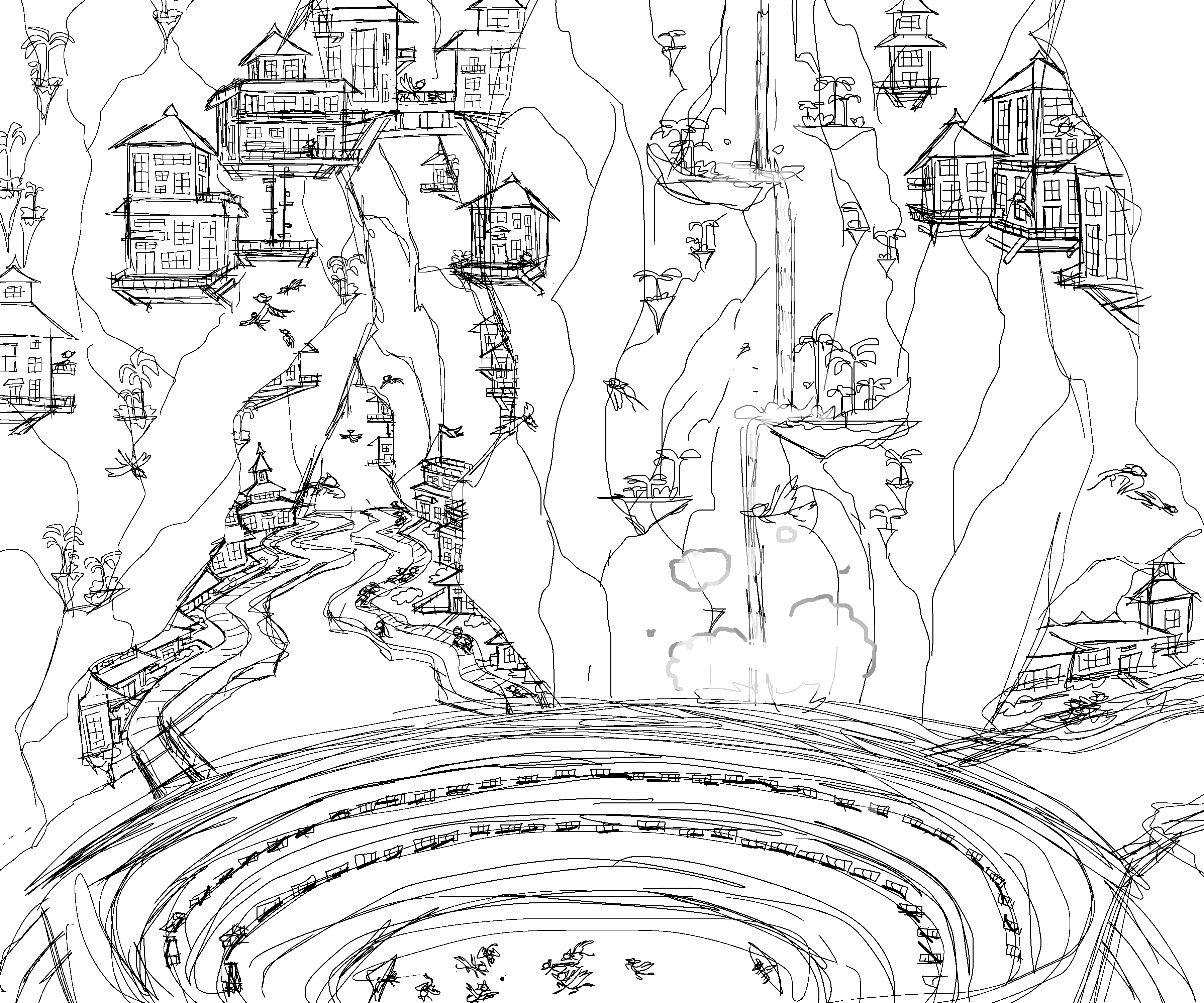
Crevolan settlements sprawled along the canyon floors, with their homes, buildings, and walkways raised high on stone support beams, made to withstand Mesaigne's seasonal floods. Streets followed the natural slot canyons, narrow but functional, with designated take‑off and landing points for flying folk. These riverside districts, though poorer, had more close‑knit communities, and served as the most common gathering places for social activities.
During dry season, being at the bottom of the canyon was a great way to beat the heat, while during the wet season, you could get a great view of the rushing rivers and giant flowers blooming just beneath the walkways.
Wealthier citizens, on the other hand, built a majority of their structures into the canyon walls themselves, or even atop the sun-baked plateaus, connecting these structures with bridges and suspended walkways supported by wooden beams that were anchored directly into the stone. Far above the canyon floors, these districts were much more secure from floods and structural collapse, but much more exposed to the pelting rays of the sun - especially for those up on the plateaus.
Many were aware of this tradeoff - and sometimes it wouldve actually been the determining factor to choose such a place. Dealing with the heat, and being literally above everyone else, was a social statement, basically saying "Hey, if I can be all the way up here and not complain about it, I must be pretty strong". That, and... there was also the luxury of flying much more freely in the open air. Reflecting these motives, elite stadiums, festivals, and gatherings were often held on the plateaus.
Most buildings, whether poor or wealthy, were constructed from clay, with stone or wooden accents. Other buildings were carved directly into the canyon walls, their outer walls formed from the same red, cobbled stone that was chipped away. Their streets often featured decorative trees transplanted from cliffedges, planted in the middle of walkways or beside houses. Buildings were typically white, grey, or pale brown, with gold or black patterns painted across roofs, walls, and window trims.
Decorations included stones, moss, hanging crystal and metal beads, as well as shed feathers used as decoration for tapestries. Family homes often displayed saved eggshells from their children as cherished keepsakes.
Technology
Leading up to their presumed extinction, the Crevolans utilized steampunk‑like technology, though with much more ornamentality to it. All of their heating, vehicles, and infrastructure were powered by steam, drawn from large water reserves replenished during the rainy season and carefully rationed in the dry months.
City lighting was produced by heated gas lamps, glowing with a dingy yellow hue similar to the sulfur lamps we have here on Earth. This gave Crevolan cities a uniform golden glow at night.
Their most advanced vehicles were winged, blimp‑like airships with air‑conditioned cabins, capable of carrying large groups of citizens. These luxury vessels functioned much like cruise ships, lifting passengers high above the plateaus and into the clouds - an experience otherwise impossible, as Crevolans lacked the stamina to fly to such heights by themselves.
Other, more common vehicles included similarly winged, steam‑powered air‑trains, used primarily as ferries between canyon floors and plateaus, as well as for general public transport. They also had what was basically a swiss army knife of a construction vehicles, a treaded vehicle built to scale canyon walls, equipped with a steam‑powered arm that could be fitted with different attachments for digging, lifting, etc. For individual travel, Crevolans used quadrupedal bicycles, which they called "quadcycles”. their only non‑steam powered vehicles. These were simple, practical, and served as the most accessible form of transport across all classes.
...Though, a lot of less-than-bright people would try flapping their wings to take off while on a quadcycle... and a lot of people ended up with injuries from losing balance midair... or, others ended up with injuries from getting a whole quadcycle dropped from the sky onto them. Fun!
Biology
Appearance
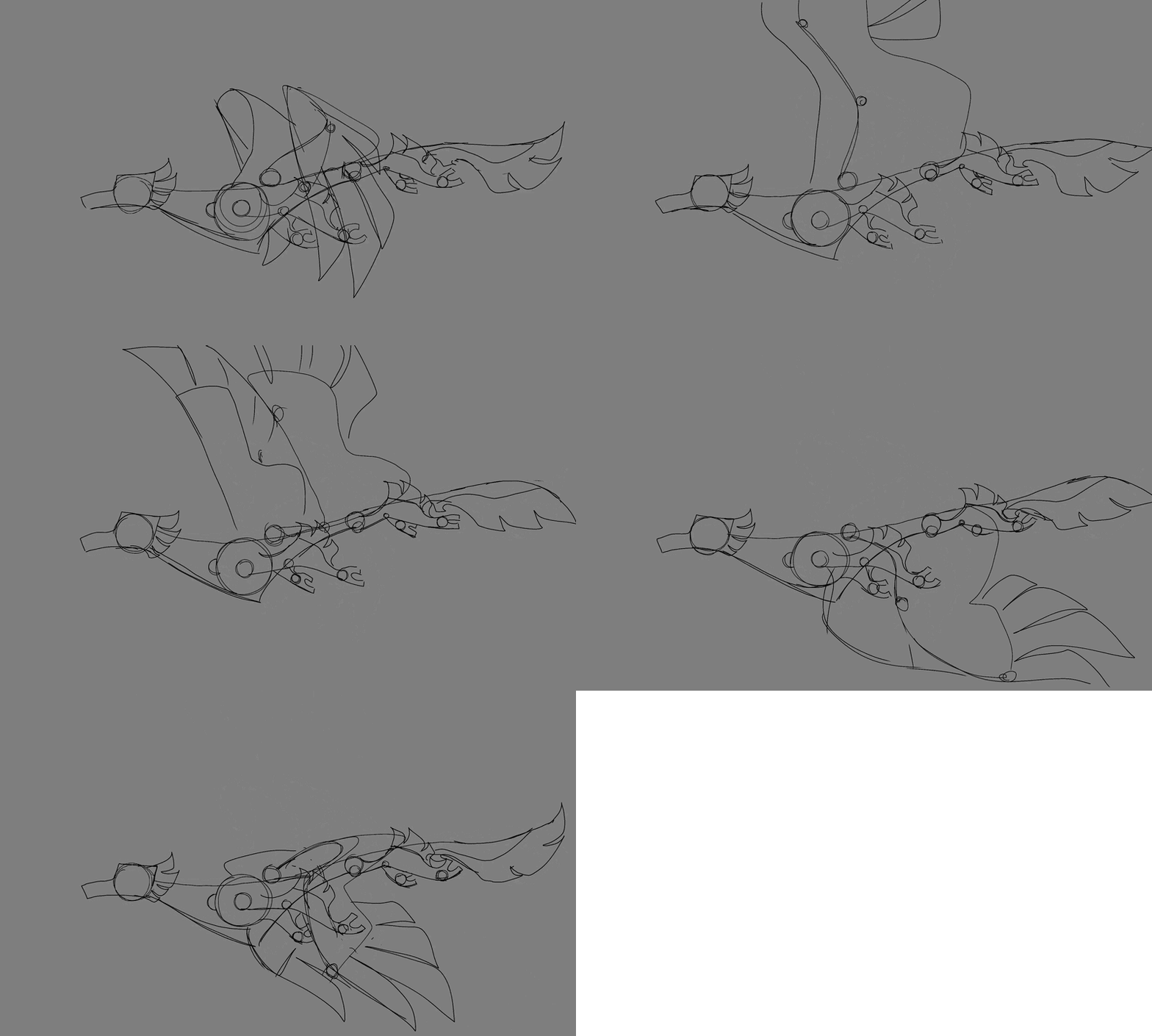
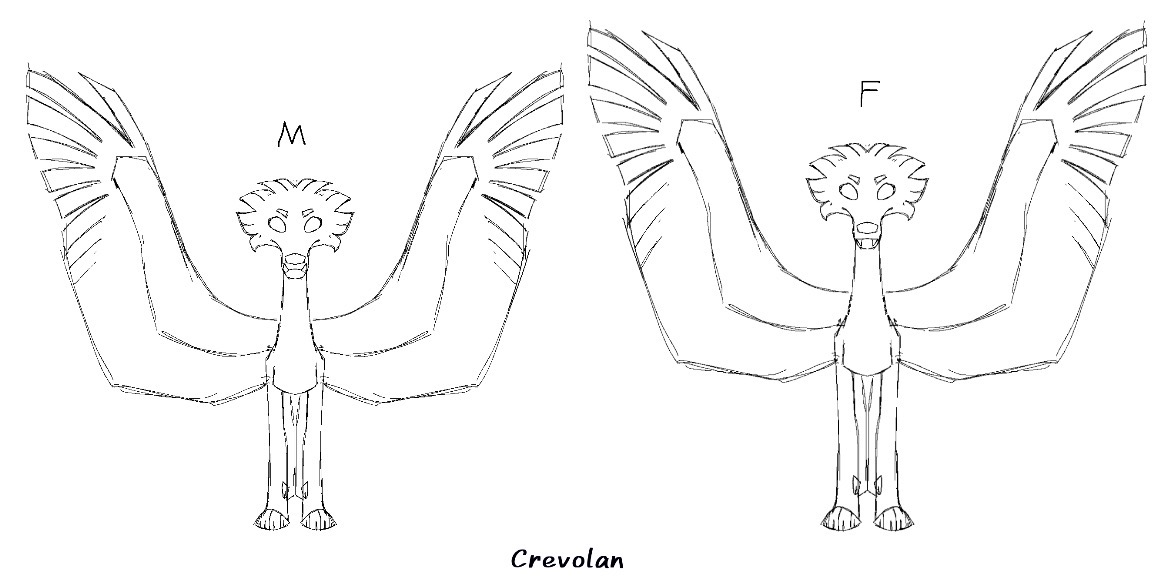
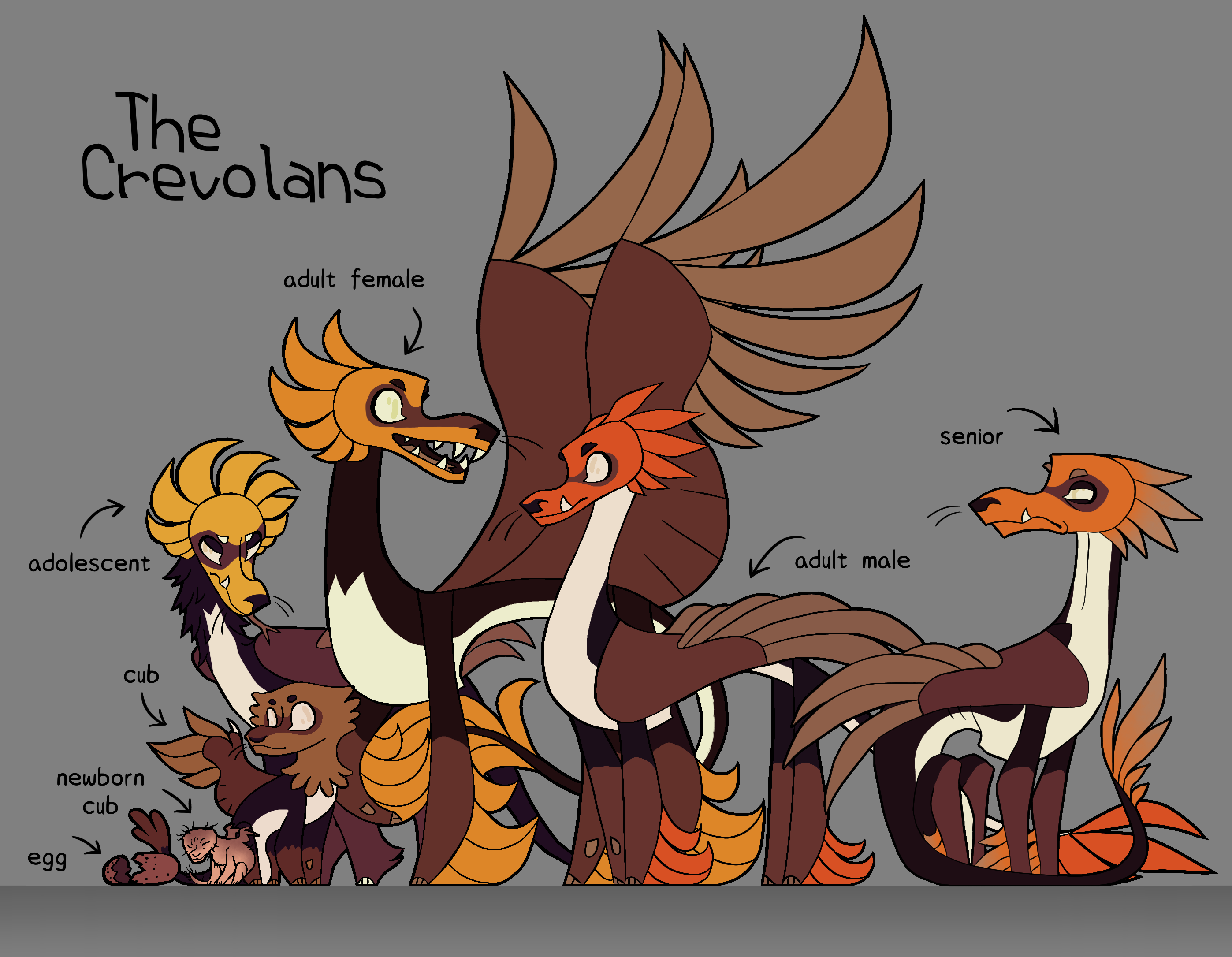
Crevolans were quadrupedal, with digitigrade legs ending in padless paws, complete with retractable claws. On their backs, they carried large wings, ones primarily built for agility and sharp turns. Crevolans with the sharpest primary feathers and largest wings were considered a beauty standard.
Their bodies were covered in small, rounded feathers, predominantly black across their coat, with off-white necks and bellies, and then having rusty brown markings along the lower limbs and wings. On their heads, ankles, and tails, they had decorative plumage ranging in color from sunny yellows to coral reds. These feathers were primarily used for mating displays, though those on the ankles and (especially) the tail also aided in flight stability. They were able to ruffle and flatten all of their feathers at will, though they'd often also move their feathers in response to their emotions.
They had milky-white compound eyes, much akin to dragonflies, complete with dark nicitating membranes that worked like built-in sunglasses... and also as windshield wipers.
Bodily Functions
If their compound eyes didn't help them find prey, their sense of smell definitely would've, as they were able to use both their nose and forked tongues to detect even the vaguest smells with ease! They had a very sensitive sense of smell, sometimes even being better than their vision entirely.
They were cold‑blooded, an adaptation to the year‑round heat of their homeplanet. They basked in patches of sunlight that shone down from the cliffside canopies above, and their feather coats allowed them to retain absorbed heat well, so long as they kept themselves well‑preened. If they overheated, they cooled down by fanning their feathers wide and panting.
They were hypercarnivores, with 70–85% of a healthy diet being meat and animal products, which they would occasionally supplement with soft-textured fruits and fungi. They had sharp, cat‑like teeth, with no molars - and with their long foreguts and small hindguts, their digestive system was specialized for meat - meaning any fibrous plants simply couldn't be processed, and would often cause illness or blockages if consumed.
Crevolans had quick metabolisms to suit their pursuit hunting, flying lifestyles - this meant that, typically, five meals per day was the norm. Some could manage on three meals along with small snacks, though this was often practiced as a form of weight control, basically being a form of fasting for them. This high metabolic rate also meant they needed to be awake for longer to accomodate their eating needs. Most Crevolans woke up at sunrise, and remained awake until midnight. This would be like us humans waking at 5 AM and sleeping at 12 AM, only getting 5 hours of sleep, every single day!
Their ancestors hunted by clinging to cliffedges or tree trunks, remaining near-motionless until they detected movement. Once motion was spotted, they would dart after the source, chasing their prey in flight until they could corner or outspeed it. As they evolved to be more intelligent, they became eusocial, and families (father or no father) remained together even after cubs fledged, spreading out over small areas to hunt or forage, pooling their gathered food into a shared pantry. This hunting behavior remained in the Crevolans' modern society, though as a recreational sort of tradition between family members, usually done on certain holidays.
Life Cycle & Reproduction
Crevolans were mostly akin to monotremes, though with some differences. Females laid clutches of 4-6 hard‑shelled eggs, and after hatching, they would nurse their altricial cubs on six nipples along their bellies. The cubs were like a mix of kittens and baby birds - eyes closed, unable to walk, covered only in a thin, patchy coat of fuzz. Until adolescence, they had claws on their wings much like Hoatzins.
During Mesaigne's wet season, males would perform elaborate mating dances for females, showing off their tusks and wings. If the female obliged, they would form a monogamous pair. The two would nest together, and once the eggs were laid, the female would dedicate herself to guarding and tending to her clutch, while the male provided food and other resources.
These relationships typically lasted a few years before the male would seek a new partner - though in modern Crevolan society, pairings happened more for love than for making babies, and so they typically lasted longer.
Sexual dimorphism was quite noticable: males were smaller, faster, and had elongated lower canines. In contrast, females were larger and a bit heavier set, and had elongated upper canines.
Trivia
- Their theme takes after a lot of things - but most majorly, ancient egyptian society, fantastical griffins, and golden eagles were my most major inspirations.
- I would say exactly what their species name is based off of, but I forgot... I do know it's a lot of scientific bird names mixed together, though!
- tba
- tba
More Images