Species / The Dynamunculi
Status:
Alive
Diet:
Omnivore
Abilities:
Bioluminescence, wallclimbing, tolerance of hypoxic environments, cutaneous respiration
Origin:
Serinox
Avg. Height:
3'8" ft
Avg. Weight:
190 lbs
The Dynamunculi (singular Dynamunculus) are quadrupedal sophonts native to the boggy forests of Serinox. Their culture is shaped by a zodiac-like religion that assigns personality and social rank according to the size and shape of one’s horn. Beyond that, though, the Dynamunculi are better known for their technological innovation, serving as the most common producers of weapons, tools, appliances, and vehicles across the galaxy.
Culture
Traditions & Society
tba
Cities
tba
Technology
tba
Biology
Appearance
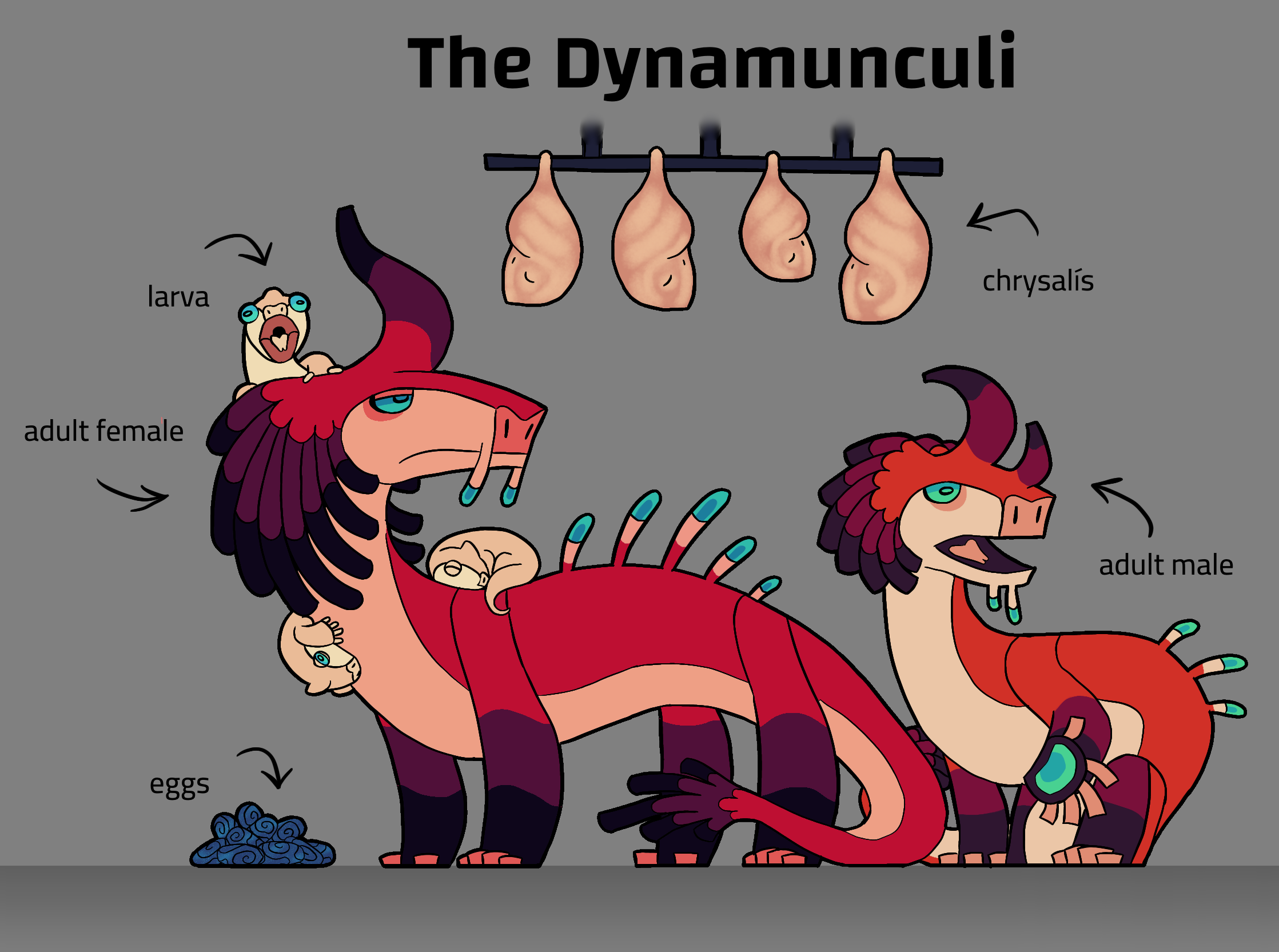
The Dynamunculi are quadrupedal sophonts with stocky, plantigrade limbs, ending in softened-keratin fingers, and with each foot having opposable thumbs. They can stand on their hindlegs, though they rarely walk around this way, as it quickly gets uncomfortable for most. Their prehensile tails - tipped with also-prehensile tentacles - allow them to wrap their tails around things, whether it's to grab something far away, or to hang from things... though the latter gets harder to do with age.
Their heads are rather rectangular, with a notable facial ridge, broad nose, side‑set half‑circle eyes, and more prehensile tentacles on the backs of their heads. They carry horns on their foreheads, varying from person to person in curvature and size.
Their smooth, hairless skin resembles that of amphibians, notably oily to the touch. Body colors consist of a small range of reds, with purple‑to‑navy markings on their limbs, tentacles and horns, contrasted by pale beige undersides.
The most distinctive trait of a Dynamunculus is their bioluminescence, though on Serinox, it's rather commonplace among both flora and fauna. Their glowing features range from sky blues to emerald greens, emitting a consistent amount of light as oxygen circulates through their blood - though the light brightens with each inhalation, and fades if they hold their breath.
Bodily Functions
The Dynamunculi's adaptations reflect their homeplanet well; a dense, smoggy, toxic atmosphere, fluctuating oxygen levels, and two suns making for near-constant muggy heat. Their lungs have moisture‑resistant alveoli, preventing fluid buildup, but leaving them vulnerable to dehydration if they end up in dry air. They breathe primarily through their lungs, though their air intake is also supplemented by cutaneous respiration.
Their circulation is powered by six‑chambered hearts, maximizing oxygen delivery. Their blood, which is a deep blue when spilt, holds oxygen efficiently in their environment thanks to their copper-based carrier, though this also means they need to consume copper regularly to keep stable amount in their blood. Homeplanet Dynamunculi get thiscregularly through their local food, while offplanet people may need to take supplements.
As cold‑blooded sophonts, they rely on the ambient temperature around them for warmth. On Serinox, warmth is sufficient, but off‑world Dynamunculi easily get cold, lacking really any insulation. They compensate by bundling up, or simply heating their surroundings... by quite a lot. To cool down, they pant and/or sprawl on a bed or other surface to shed heat.
They're omnivores with a focus on insects, insect larvae, crustaceans, and plant leaves, stems, and occassionally their roots. They have human‑like teeth, with flat incisors and crushing molars, well‑suited for breaking down the fibrous plants and tough insects they consume. They have short foreguts and long hindguts. With a slow metabolism, they need to eat only a few times per week, and they expel crystalline waste pellets roughly every other week.
A healthy sleep schedule for a Dynamunculus usually means they sleep for roughly 4 hours at dawn and dusk, occasionally having short naps inbetween those times. This reflects their slow metabolism and the fact that there's not really a noticeable day or night on Serinox, thanks to all the smog.
Dynamunculi who live on their homeworld, or spend a lot of time there, ambiently absorb the toxicity from its harsh environment, making their skin hazardous to touch for most other sophonts. This effect can fade with time away from their planet, though.
They excrete a sticky oil across their whole bodies, though they produce the most from the bases of their head tentacles. This oil is used for many things, like sticking to walls and climbing, spreading pheromones, and even becoming nutritious for feeding larvae, on females.
Their ancestors were tree‑climbing herbivores that later descended to the ground and expanded their diet to become omnivores. Over time, they made use of volcanic hot springs, first using them to kill prey, then to cook food, and eventually developing tools to refine the process.
They had a clan structure that was like a mix of lion prides and horse herds. Dominant females with the largest, healthiest horns led the clan, called a Gyne. They made all of the clan's offspring, and they were also in charge of defending the group, as well as deciding on new males. Beneath them in rank were her group of males, who served and protected the Gyne, as well as competed for mating rights. The Gyne's daughters acted as offspring caretakers and heirs to leadership, while her sons would leave the clan upon maturity to form bachelor groups, attempting to join or challenge new clans. This clan mentality still exists in the modern Dynamunculan society, though in a more civilized form.
Life Cycle & Reproduction
Dynamunculi have an insect-like life cycle, where they start out as soft-shelled, rubbery eggs, with the larva then chewing their way out and eating their eggs. The larva, with squishy, pale skin, bulging eyes, and longer tails, take around 5 months to develop, growing to half the size of an adult, before hanging by their tails on whatever they can find (caretakers usually put them on specialized hanging stations), and hardening into a chrysalis. They remain as chrysalides for around 1 month before emerging as fully-developed, aside from size, adults. They continue to grow for the rest of their lives after this, and they don't really change much in appearance as they age into seniors, aside from getting bigger.
Trivia
- Their species name is a mix of "Dynamic" and "Homunculus", since, in their early days of existing, they made me think of amphibian pig monkeys.
- tba
- tba
- tba
More Images